



Written by Gurleen and Reviewed by Dr. Manvir Bhatia-07/ 09/2026
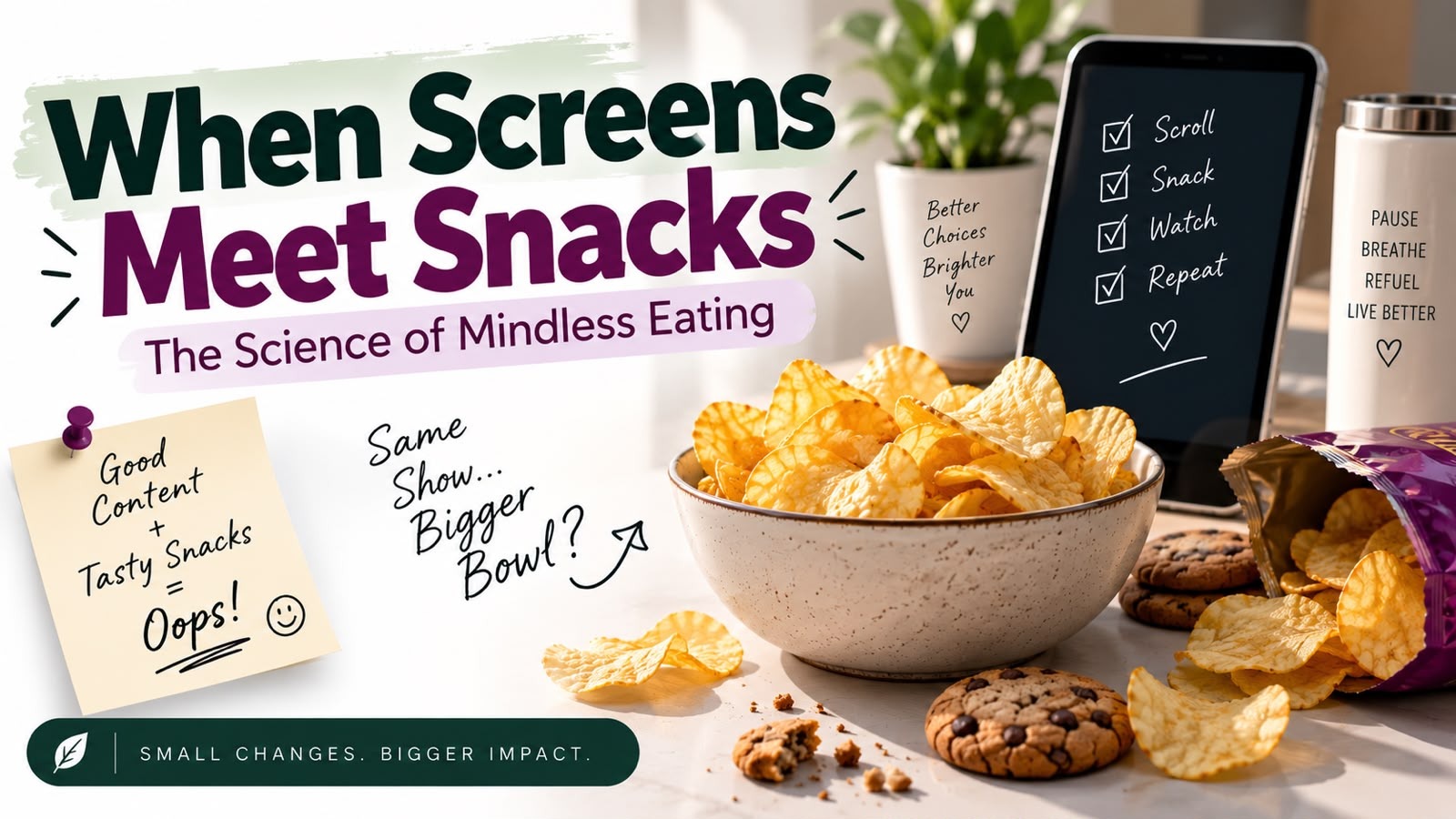
We’ve all experienced it: you sit down to watch an episode of your favorite show, open a large bag of chips or biscuits, and before the episode even finishes, your hand hits the bottom of an empty bag. You didn’t even fully register tasting the last half of it.
Welcome to the digital snacking loop.
In an era where remote work, streaming, and continuous scrolling dominate our day, our relationship with food has fundamentally transformed. Snacking is no longer just a response to physiological hunger; it has become an automatic background activity tied to entertainment, focus, and stress relief.
The Science of "Distracted Eating": Why Screens Make Us Overeat
Why does screen time make us eat more without realizing it? When your attention is divided between a screen and food, several cognitive and hormonal shifts happen at once:(reference from mdpi) ( Robinson, E., Ahern, A., Aldrich, J. A., Dawe, J., Dourish, C. T., Thomas, D. M., & Higgs, S. (2013). Eating attentively: a systematic review and meta-analysis of the effect of food intake memory and awareness on eating. The American Journal of Clinical Nutrition, 97(4), 728–742.)
Publication Year: 2013
- Delayed Fullness Cues: Your brain needs about 20 minutes to process satiety hormones like leptin and peptide YY. When your focus is captured by a screen, your brain delays registering these fullness signals, leading to passive overconsumption.
- Dopamine Stacking: Engaging content triggers a steady release of dopamine in the brain. Pairing screen stimulation with hyper-palatable foods (high in sugar, fat, and salt) creates a dual-reward loop that hardwires cravings for eating while watching.
- Impaired Food Memory: Nutritional research shows that when you don’t visually register and focus on what you’re eating, your brain fails to log a clear “memory” of the meal. Consequently, you feel hungry again much sooner.
What the Data Says: Snacking in the Digital Age
Recent public health and dietary studies highlight a strong connection between screen hours and modern eating habits: ( reference from research gate )( https://doi.org/10.3945/10.3390/nu16162769)
Dynamic | What Research Tells Us |
Ultra-Processed Food Intake | Studies show that individuals with 4+ hours of daily screen time consume significantly higher quantities of ultra-processed foods (UPFs) compared to low-screen users. |
Late-Night Cravings | Artificial light from screens suppresses melatonin production, which tricks the body into seeking quick glucose energy—leading to late-night carbohydrate cravings. |
Physical Speed vs. Satiety | Screen-distracted individuals tend to chew less and eat faster, which disrupts normal digestion and leads to higher overall caloric intake per sitting. |
4 Smart Strategies to Reset Your Snacking Habits
You don’t need to give up your favorite devices to keep your nutrition on track. Implementing a few intentional boundaries can completely change your snacking dynamics:
- The Single-Portion Rule
Eating directly out of multi-serving packages removes visual cues of how much you’ve eaten. Always transfer a single portion into a small bowl or plate before returning to your desk or couch. Once the bowl is empty, force yourself to stand up if you want more—that brief physical break is often enough to curb automatic eating.
- High-Volume, Low-Density Alternatives
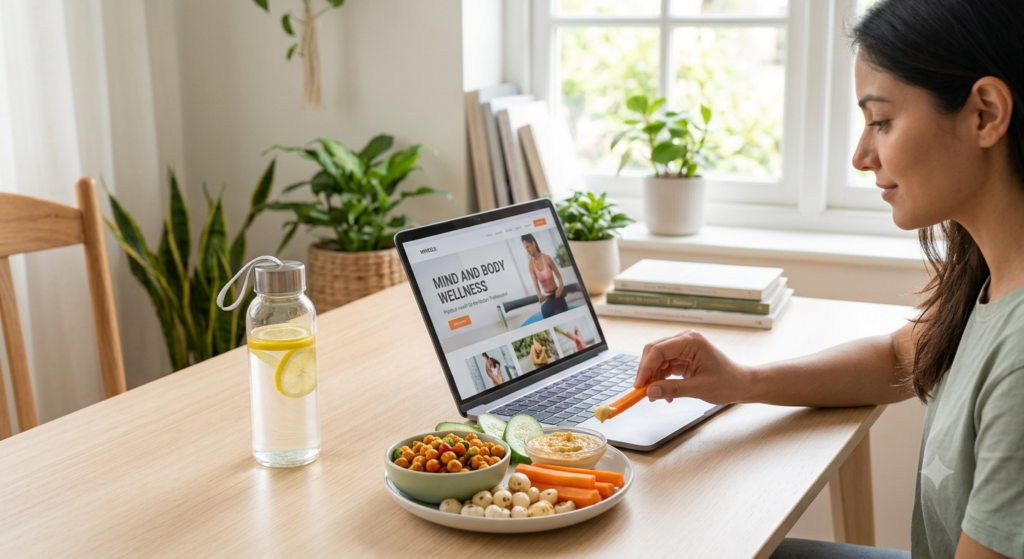
When screen time creates a desire for hand-to-mouth repetition rather than true hunger, switch to high-volume, fiber-rich options that slow down your pace:
- Roasted Fox Nuts (Makhana) or air-popped popcorn seasoned with herbs.
- Crunchy vegetable sticks (cucumber, carrots, bell peppers) served with hummus.
- Edamame in pods—the physical action of peeling each pod naturally slows down eating speed.
- Roasted chickpeas for a combination of fiber and plant protein.
- Establish One “Screen-Free” Meal Daily
Retrain your brain to register fullness by dedicating at least one meal or snack per day to pure eating. Sit away from your phone, laptop, or TV for 10–15 minutes, focusing entirely on the flavor, smell, and texture of your food.(reference from science daily)
- Create a “Digital Kitchen Closure”
Set a firm boundary (for example, 9:00 PM) after which the kitchen is closed. If you continue using screens late into the evening, keep a bottle of water or herbal tea nearby instead of food to address oral fixation without extra late-night calories.
CONCLUSION
Technology isn’t inherently bad for our diet, but unconscious consumption can quietly sabotage long-term health goals. By bringing simple awareness back to your plate and creating clear boundaries between food and screen time, you can enjoy your digital content without letting mindless snacking take over.