









The Truth About Sleep Debt: Can You Ever Really Pay It Back?
We’ve all been there. After a relentless week of late nights, early alarms, and endless scrolling, Friday night finally arrives. You collapse into bed, set your alarm for noon, and tell yourself: “I’m just going to sleep in this weekend to catch up.”
It feels like a flawless financial transaction. You owe the body ten hours of sleep, so you deposit ten hours over Saturday and Sunday, balance restored—right?
( Behavioral and Physiological Consequences of Sleep Restriction (2003))
Not so fast.
The concept of “sleep debt” is real, but how your body handles the repayment process isn’t as simple as balancing a bank account. Here is what actually happens when you try to pay back lost sleep, what science says about “catch-up” sleep, and how to actually reset your internal clock.
What Exactly Is Sleep Debt?
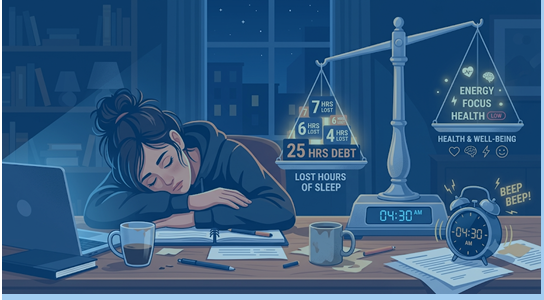
Sleep debt—also known as a sleep deficit—is the cumulative difference between the amount of sleep your body needs and the amount you actually get.
(Ad libitum weekend recovery sleep fails to prevent metabolic dysregulation during recurring insufficient sleep (2019))
If your baseline requirement is 8 hours of sleep a night, but you only sleep 6 hours every weekday, you accumulate a 2-hour debt each night. By Saturday morning, you are sitting on a 10-hour sleep debt.
Nightly Deficit: 2 Hours/day (Mon – Fri)
Total Sleep Debt by Weekend: 10 Hours
Unlike credit card debt, where the bank sends you a polite statement, sleep debt shows up in subtle, cumulative ways:
- Foggy brain and slower reaction times
- Mood swings, irritability, and heightened stress
- Weakened immune function
- Sugar and carb cravings caused by disrupted hunger hormones (leptin and ghrelin)
Can You Really “Pay Off” Sleep Debt?
The short answer? Yes, but only to a point—and not the way most people try to do it.
Research shows that while extra sleep can reverse some immediate effects of sleep deprivation (like feeling groggy or exhausted), it cannot fully undo the deep biological stress caused by chronic, long-term sleep loss.
(Harvard Medical School Division of Sleep Medicine (health.harvard.edu) & Sleep Foundation (sleepfoundation.org))
1. Short-Term Debt (A Night or Two)
If you stayed up late to finish a project or catch a midnight flight, your body is remarkably resilient. You can recover from a short-term deficit by adding an extra hour or two of sleep over the next couple of nights or taking a brief nap.
2. Chronic Debt (Weeks, Months, or Years)
If you have been running on 5 or 6 hours of sleep for months, binge-sleeping on the weekend won’t magically wipe the slate clean. Studies show that while a weekend sleep-in might make you feel momentarily refreshed on Monday morning, your cognitive performance, attention span, and metabolic health remain compromised.
The Catch-Up Sleep Trap: Why Weekend Sleep-Ins Backfire
It is tempting to think an 11-hour sleep marathon on Sunday morning will fix everything. However, “catch-up sleep” comes with its own set of hidden traps.
The “Social Jetlag” Effect
When you sleep from 11 PM to 7 AM during the week, but shift to 2 AM to 11 AM on the weekend, you confuse your body’s circadian rhythm (internal master clock).
This phenomenon is known as Social Jetlag. By shifting your sleep schedule by several hours over the weekend, you give your body the equivalent feeling of flying across three time zones every Sunday night. The result? You can’t fall asleep on Sunday evening, leading to the dreaded “Monday Morning Blues.”
Metabolic Confusion
A study from the University of Colorado Boulder found that people who relied on weekend catch-up sleep to offset weekday sleep loss still experienced reduced insulin sensitivity and gained weight. Binge-sleeping disrupted their metabolic rhythm even further than continuous short sleep.
The Smarter Strategy: How to Safely Pay Off Your Debt
If you find yourself deep in sleep debt, don’t panic. You don’t need to accept permanent exhaustion. Instead of drastic weekend marathons, use these gradual, sustainable strategies to reset your body.
(Social Jetlag: Misalignment of Biological and Social Time (2006))
RECOVERY GAME PLAN:
[Short Nap: 20-30 mins] ──► Restores focus without deep sleep inertia
[Early Bedtime: +30-60 mins] ──► Slowly repays debt without shifting rhythm
[Consistent Wake Time] ──► Keeps circadian clock anchored
1. Pay it Back in Micro-Installments
Instead of sleeping in 3 hours late on Saturday, go to bed 30 to 60 minutes earlier every night for a week. This incrementally pays off the debt without throwing off your natural circadian rhythm.
2. Master the Power Nap
If you are struggling through an afternoon slump, a 20-to-30-minute power nap between 1:00 PM and 3:00 PM can help restore alertness and cognitive function. Keep it under 30 minutes to avoid entering deep sleep, which leaves you feeling groggy upon waking.
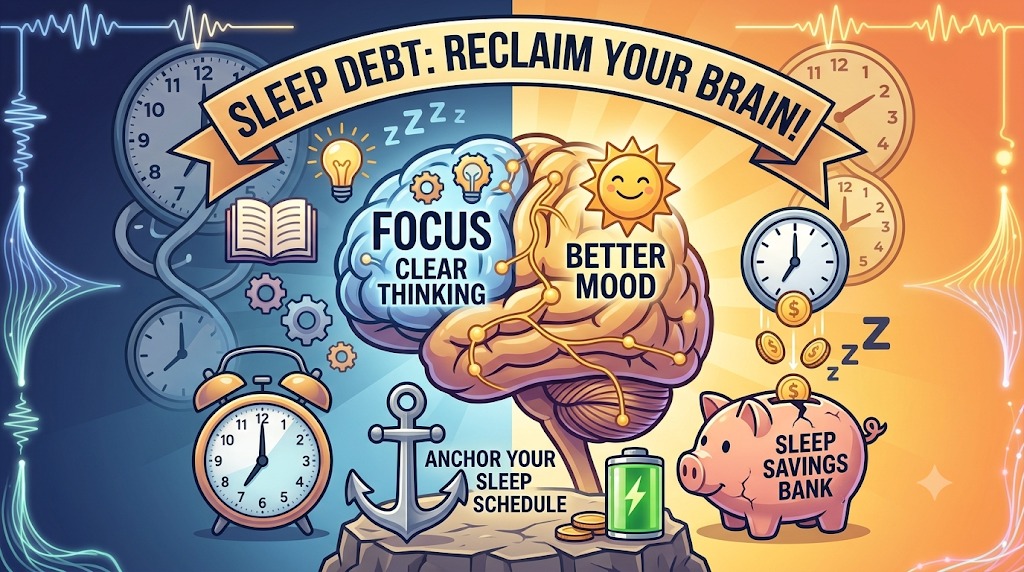
3. Anchor Your Wake-Up Time
Your body craves predictability. Keep your wake-up time consistent—even on weekends—within a 30-to-45-minute window. Anchoring your morning alarm stabilizes your natural sleep pressure, making it much easier to fall asleep at night.
The Recovery Timeline: How Long Does It Take?
Recovering from sleep debt isn’t instantaneous. Here is a general timeline of what to expect based on your sleep deficit:
| Loss Level | Recovery Time Needed | Best Strategy |
| 1 Night (2-3 hrs lost) | 1–2 days | Go to bed 1 hour earlier; take a 20-min power nap. |
| 1 Week (10+ hrs lost) | 1–2 weeks | Add 30–60 mins of sleep every night consistently. |
| Chronic (Months of loss) | Several weeks to months | Establish a strict sleep routine; prioritize sleep hygiene. |
Final Thoughts: Prevention Over Repayment
Sleep isn’t a luxury or an administrative task you can put off until Saturday morning. It is a biological necessity—just like hydration and nutrition.
While your body is remarkably adaptable and will accept short-term recovery sleep, the ultimate goal should always be consistency over catch-up. Treat your sleep schedule like an important daily appointment with your health. Your mind, mood, and body will thank you every morning.